Can a "thermonuclear" review skill stop the AI slop?
A hands-on lesson in automated code review for AI agents. You will read the actual Cursor "thermonuclear code quality review" skill, watch it tear into a real codebase, and learn to judge what a review skill should (and shouldn't) do.
💡 Dotted words are definitions
Any underlined term has a plain-English definition. Hover it on desktop, or tap it on mobile, to pop it open.
✅ Quizzes keep score
Each section ends with a multiple-choice check. Your running score sits in the top bar; a final tally waits at the end.
Why automated code review matters
Matt Pocock opens with a blunt claim: automated code review is "one of the most impactful ways that you can improve the code quality coming out of your agent." 0:00
The logic is simple. When an AI agent writes code, the fastest way to raise its quality is to have a second agent review that code against a strict standard, before a human ever looks at it. Matt already keeps his own review skill in a public repo (109,000 stars at the time of filming), but he marks it "in progress" because he isn't happy with it. So he does what good engineers do: he goes hunting for other people's skills to steal ideas from.
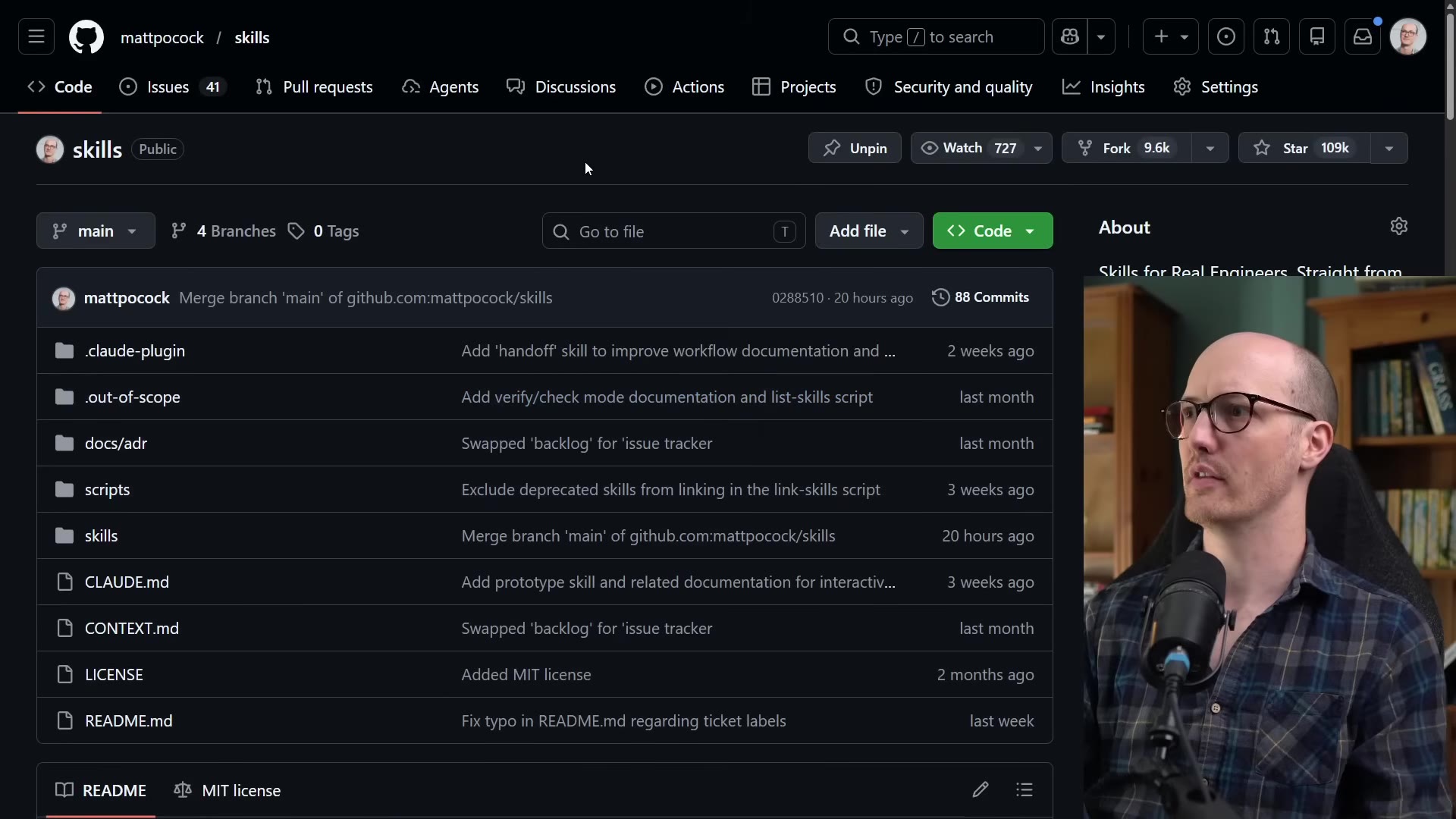
mattpocock/skills repo, "Skills for Real Engineers." His own review skill lives here, still marked in progress.According to Matt, what makes automated code review so valuable for AI-generated code?
Meet the "thermonuclear" skill
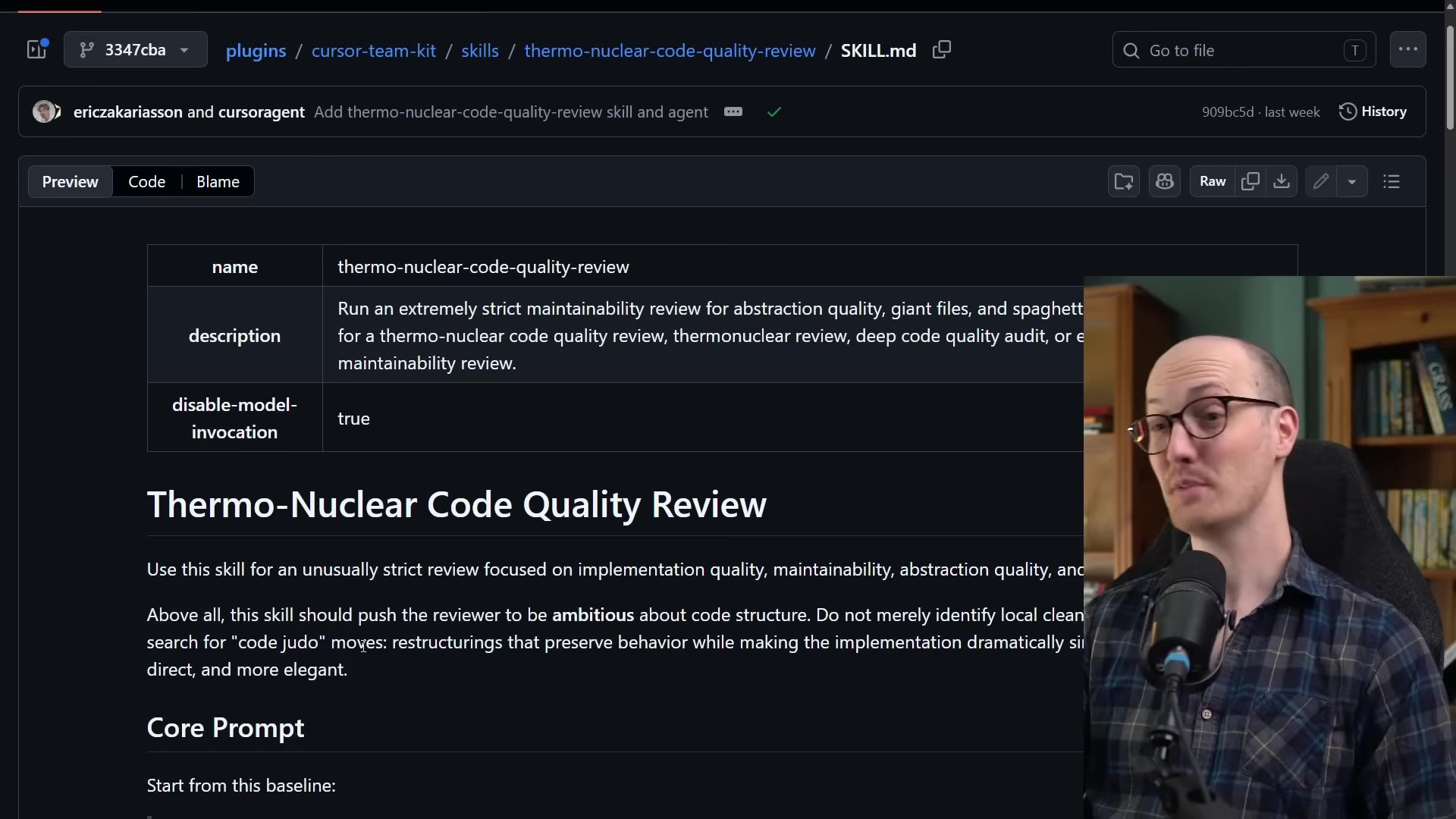
The skill that catches Matt's eye comes from the Cursor team. It's called thermo-nuclear-code-quality-review, and it's just one file: a single SKILL.md. Its description promises "an extremely strict maintainability review for abstraction quality, giant files, and spaghetti." 0:39
What Matt finds notable is how ambitious it tells the reviewer to be. Most review prompts are timid. This one explicitly tells the reviewer to hunt for "code judo" moves: restructurings that preserve behavior while making the code dramatically simpler.
What is a "code judo" move, in this skill's vocabulary?
Running it on a real codebase
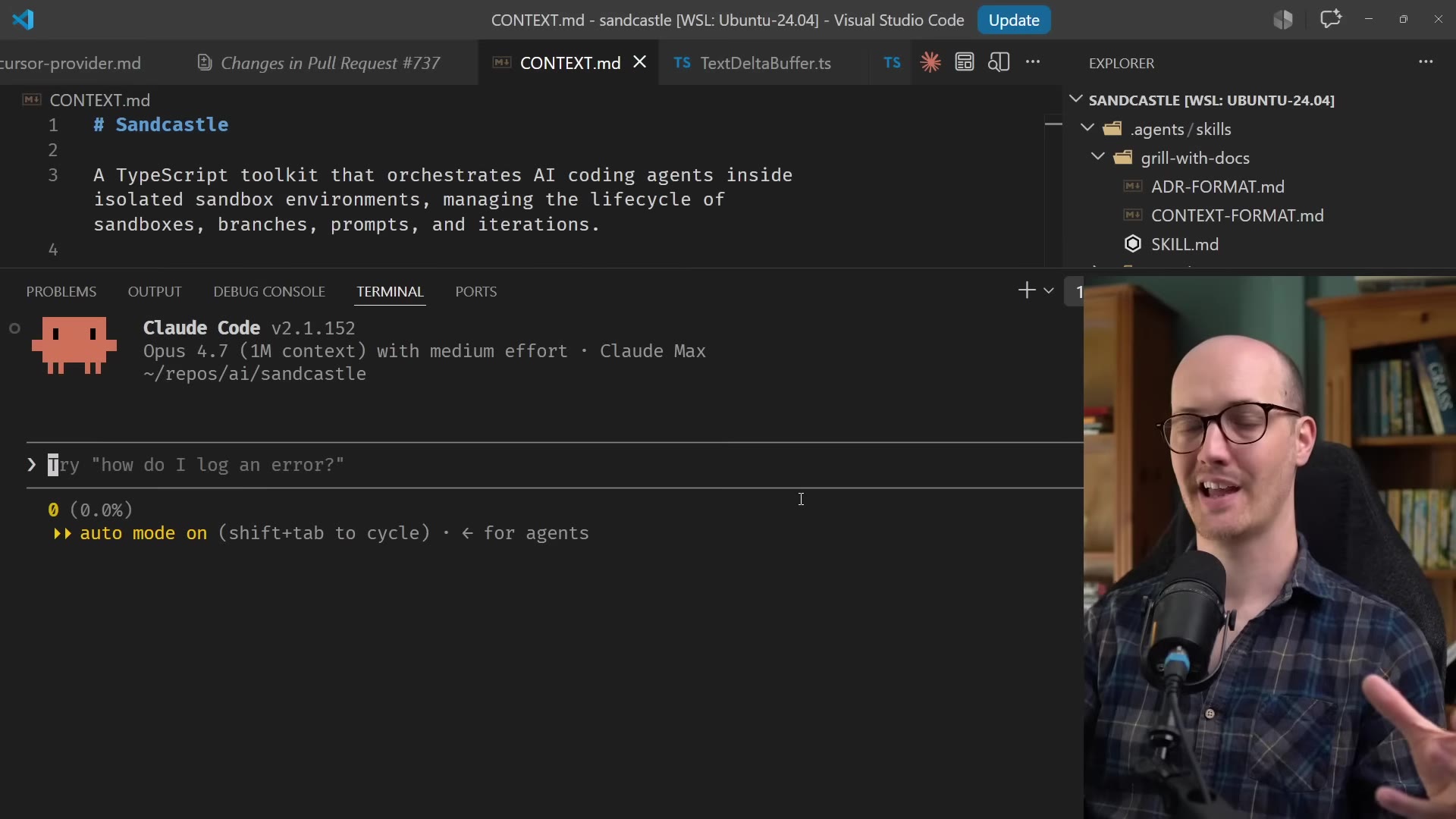
Matt copies the skill to his machine and points it at Sandcastle, his open-source "software factory" (a TypeScript toolkit that orchestrates AI coding agents inside isolated sandboxes). His command is deliberately loose:
"thermonuclear code quality review, review the last five PRs that made it to main."Run on Claude Code, in auto mode, while he reads the skill aloud.
Why does running the review in "auto mode" matter for this experiment?
Inside the skill: the rules that matter
While the agent works, Matt reads the skill top to bottom. This is the heart of the lesson: what actually makes a review skill good.
The baseline: be ambitious, look past the diff
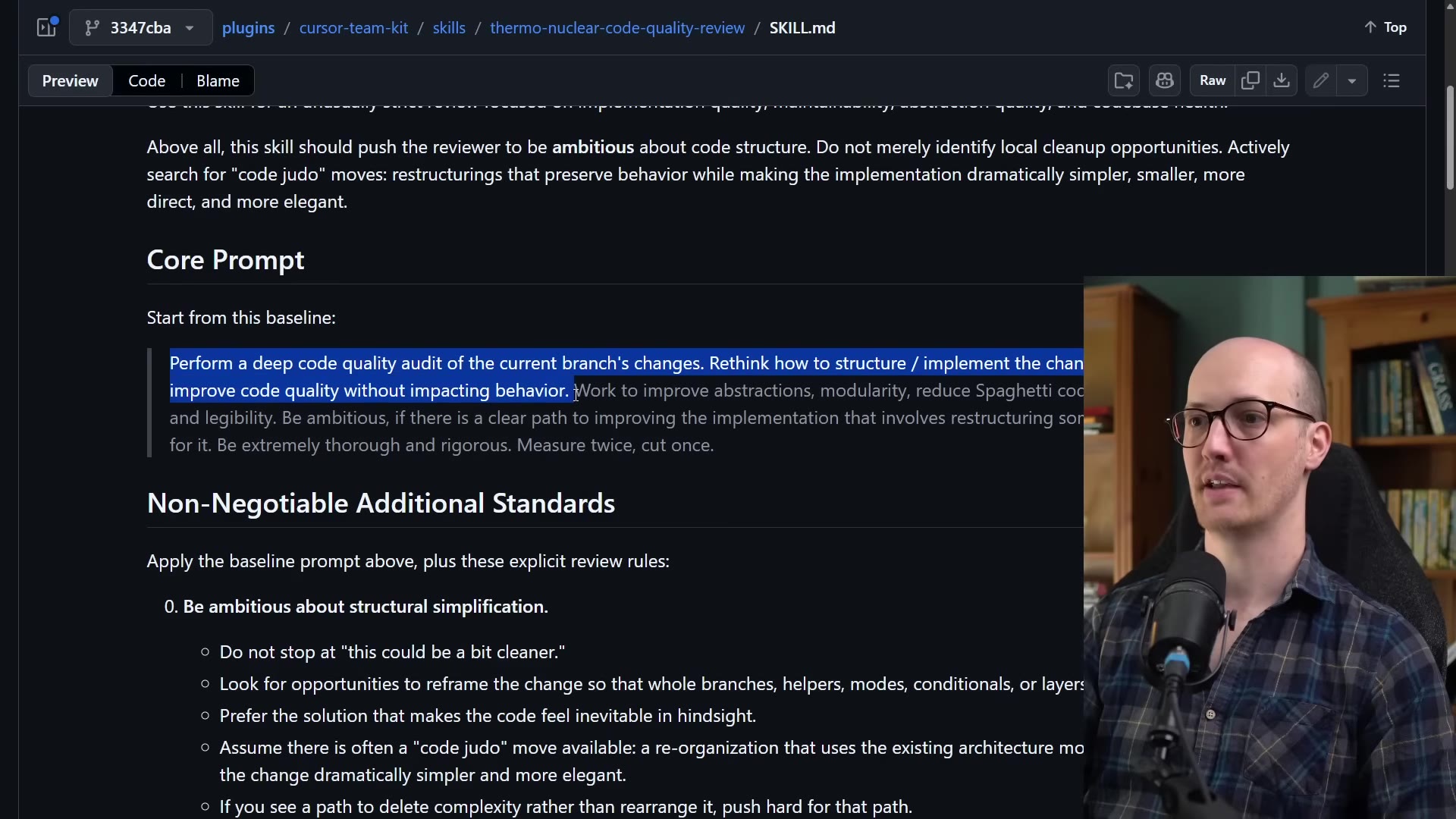
The core prompt starts: "Perform a deep code quality audit of the current branch's changes… Rethink how to structure / implement the changes to meaningfully improve code quality without impacting behavior… Be ambitious… Measure twice, cut once." 2:25
Matt's key insight: most review skills fail because of diff bounds. Hand an agent a diff and it treats that diff as the walls of its world. This prompt breaks out of that, telling the reviewer to scan the whole codebase for opportunities, starting from the branch's changes.
The one rule everyone remembers: the 1,000-line wall
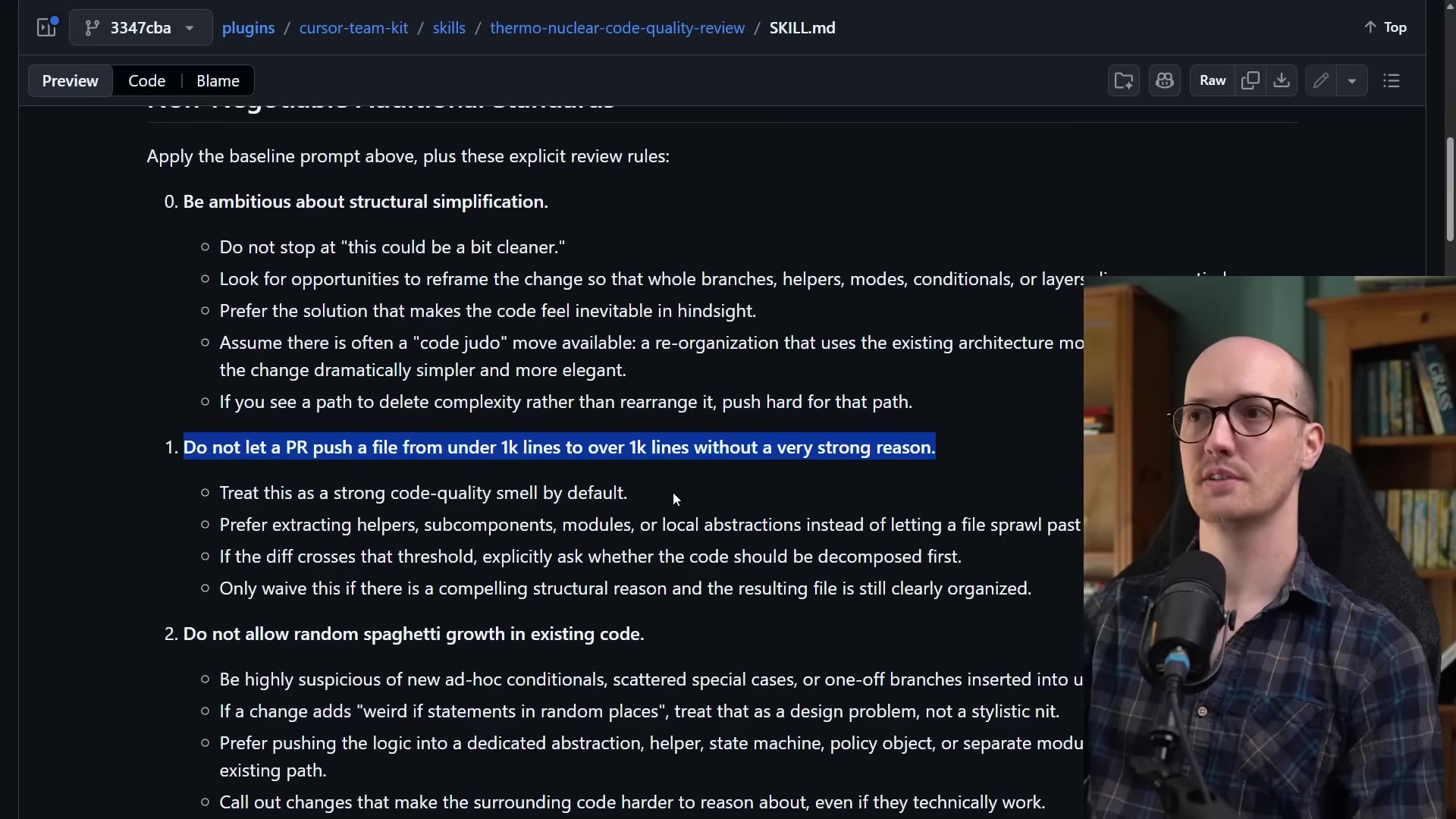
Rule 1: "Do not let a PR push a file from under 1k lines to over 1k lines without a very strong reason." Matt reached the same conclusion on his own. Big files hurt agents because to find one useful function, the agent must load the entire file into its context window. Splitting into smaller files lets the filename act as a pointer to what's inside, far more context-efficient. (His personal rubric is 5,000 tokens rather than 1,000 lines.)
Rule 2 is the anti-spaghetti rule: if a change adds weird if statements in random places, treat it as a design problem, not a stylistic nit. Push the logic into a proper abstraction, helper, state machine, or policy object instead.
Types, canonical helpers, and parallelism
More standards worth stealing:
- Prefer direct, boring, maintainable code over hacky, magical code (an echo of Claude Code's
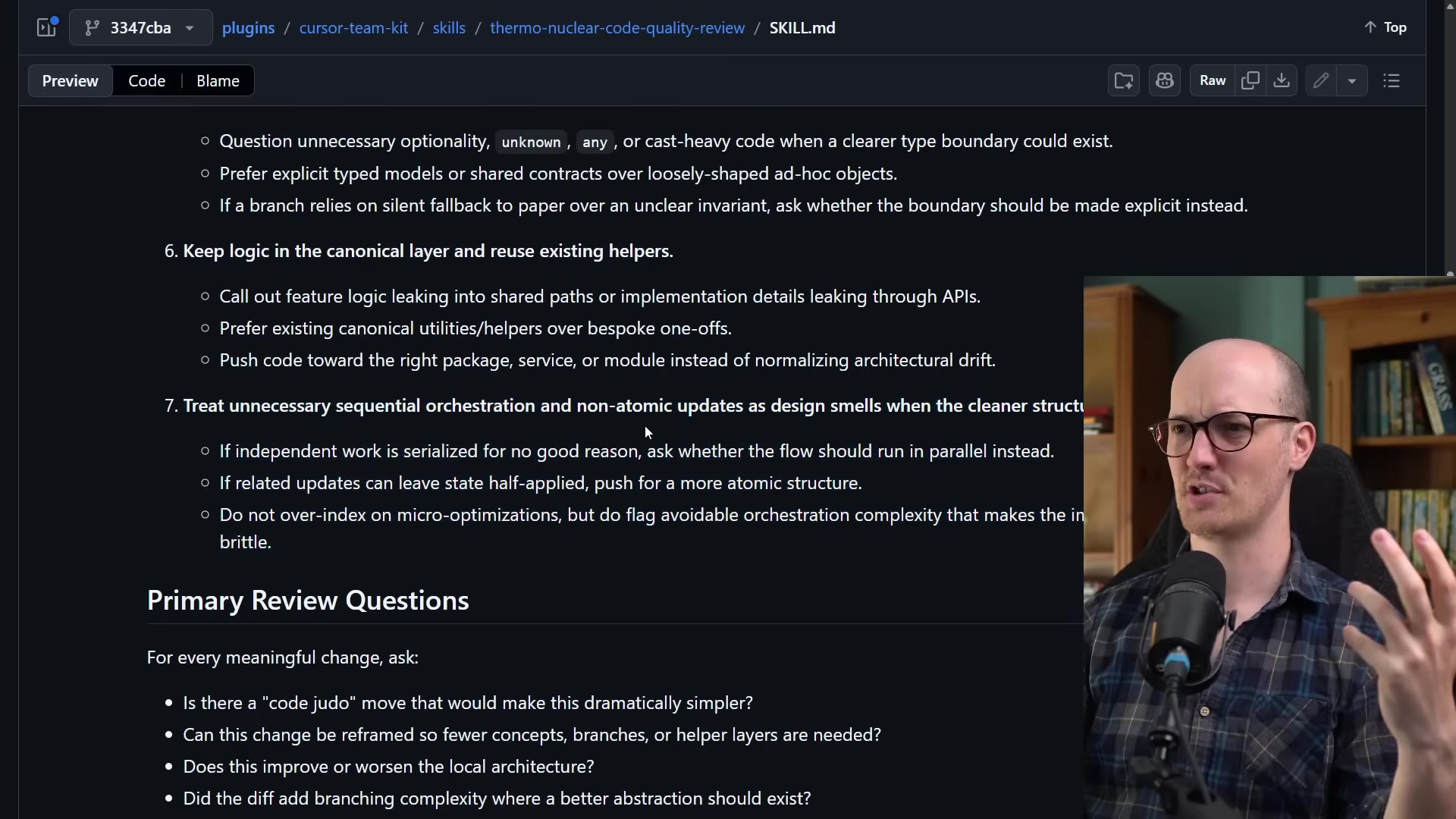
simplifyskill). - Push hard on type boundaries: question unnecessary optionality, unknown, any, or cast-heavy code. Matt's pet peeve: agents mark every new prop optional even when it's always required, just to shrink the blast radius.
- Keep logic in the canonical layer and reuse existing helpers over bespoke one-offs.
- Treat needless sequential orchestration as a design smell (run independent work in parallel), but don't over-index on micro-optimizations. Matt calls this rule's wording "word salad."
Then the Primary Review Questions for every change: "Is there a code judo move that would make this dramatically simpler? Can this be reframed so fewer concepts / branches / helper layers are needed?" Matt loves those. He dislikes "Does this improve or worsen the local architecture?", because "improve or worsen" means nothing to an agent unless you define what good and bad look like. 5:45
Output rules: prioritize, don't flood
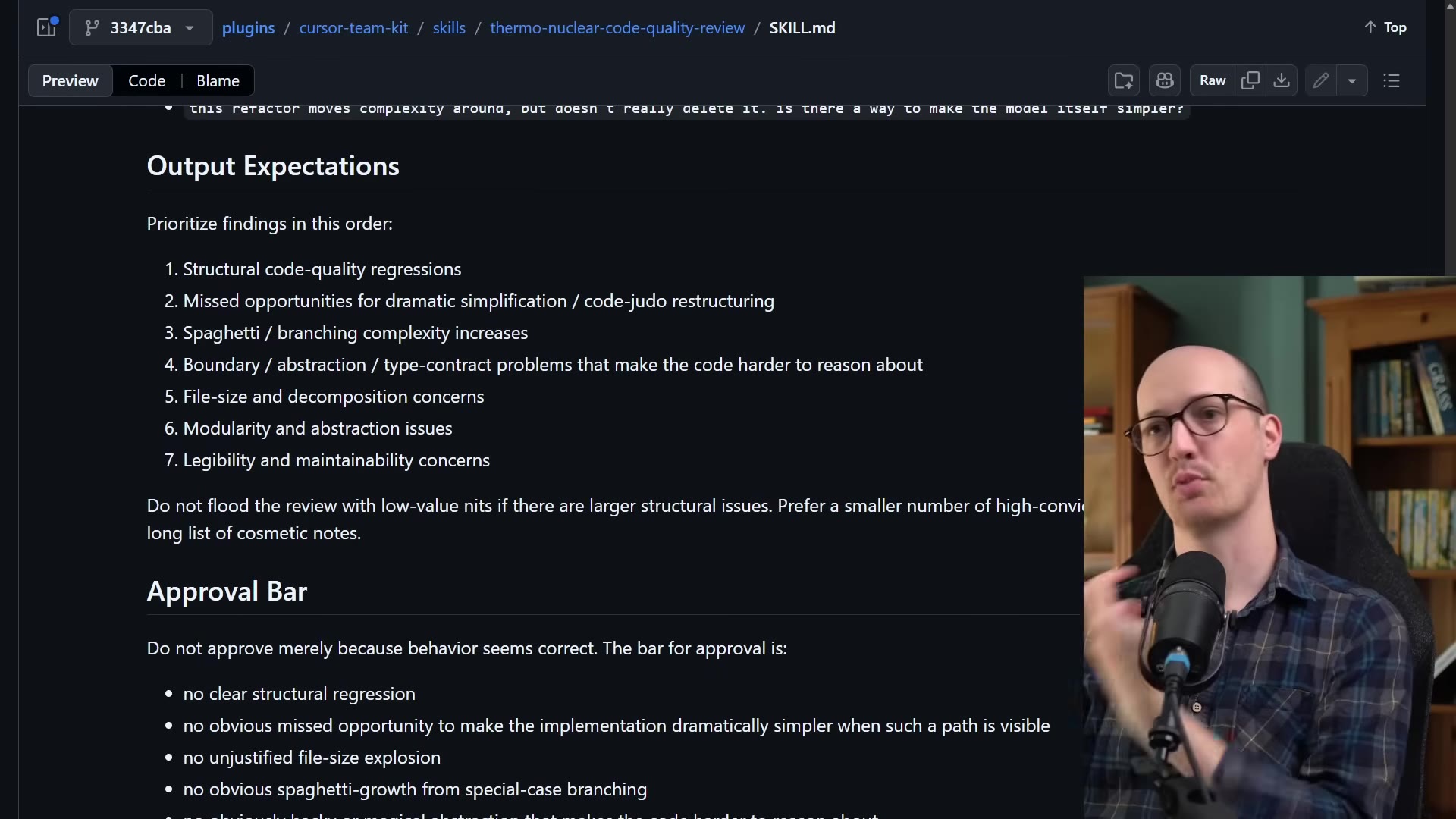
Finally the skill sets output expectations: report findings in a fixed priority order (structural regressions at the top, legibility at the bottom) and "do not flood the review with low-value nits." Then an explicit approval bar: do not approve just because behavior seems correct. Matt's worry: the whole thing is a "huge ball of mud", and it's genuinely hard for the agent to know what to prioritize inside so much repetitive text. 7:38
What failure mode does telling the reviewer to "be ambitious and look past the diff" specifically fix?
Why does the skill care so much about keeping files under ~1,000 lines?
Did it actually find anything?
The agent reviewed the last five PRs to main and sorted its findings into tiers. This is where you learn to grade a reviewer, keeping the good calls and dismissing the false positives.
Blocker-class: the 1,094-line file
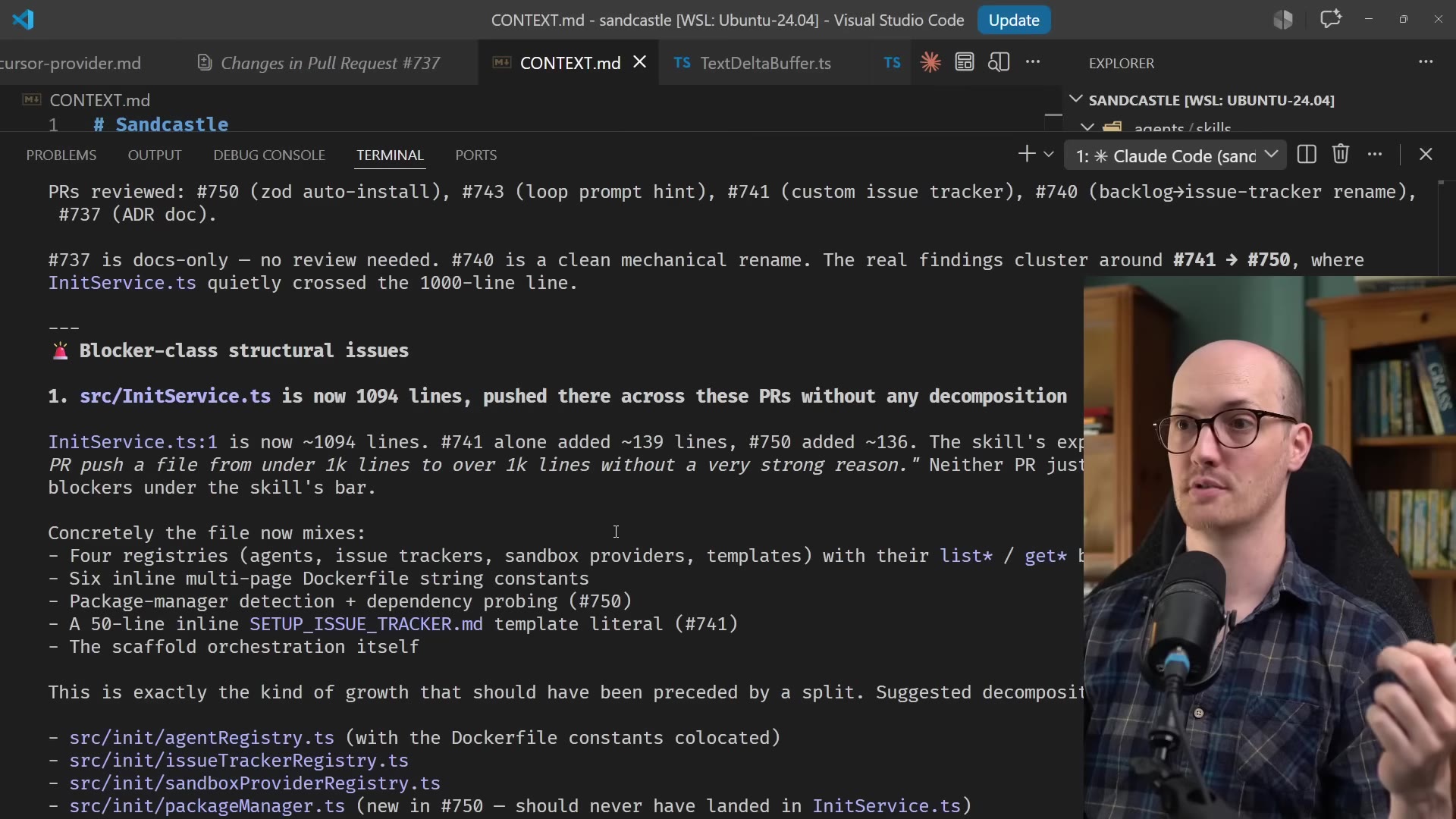
Top finding: InitService.ts is now 1,094 lines, grown across these PRs with no decomposition. It mixes four registries, six inline Dockerfile constants, package-manager detection, and more. The agent proposed splitting it into per-registry modules, and adding a generic makeRegistry function to delete ~20 lines of duplicated boilerplate. Matt's score: two for two, both genuinely good. 8:48
A good call and a false positive, side by side
On PR #741, the reviewer spotted a feature-specific special case scattered across three layers (if issueTracker.name === 'custom') and suggested pushing that variation into the type itself, a real code judo move. Good call. But it also flagged templateArgs for carrying both real shell commands and prose markers, proposing a discriminated union. Matt knows this code and calls it a false positive from an inaccurate mental model, "which is okay", because a false positive is cheap to say no to. 9:20
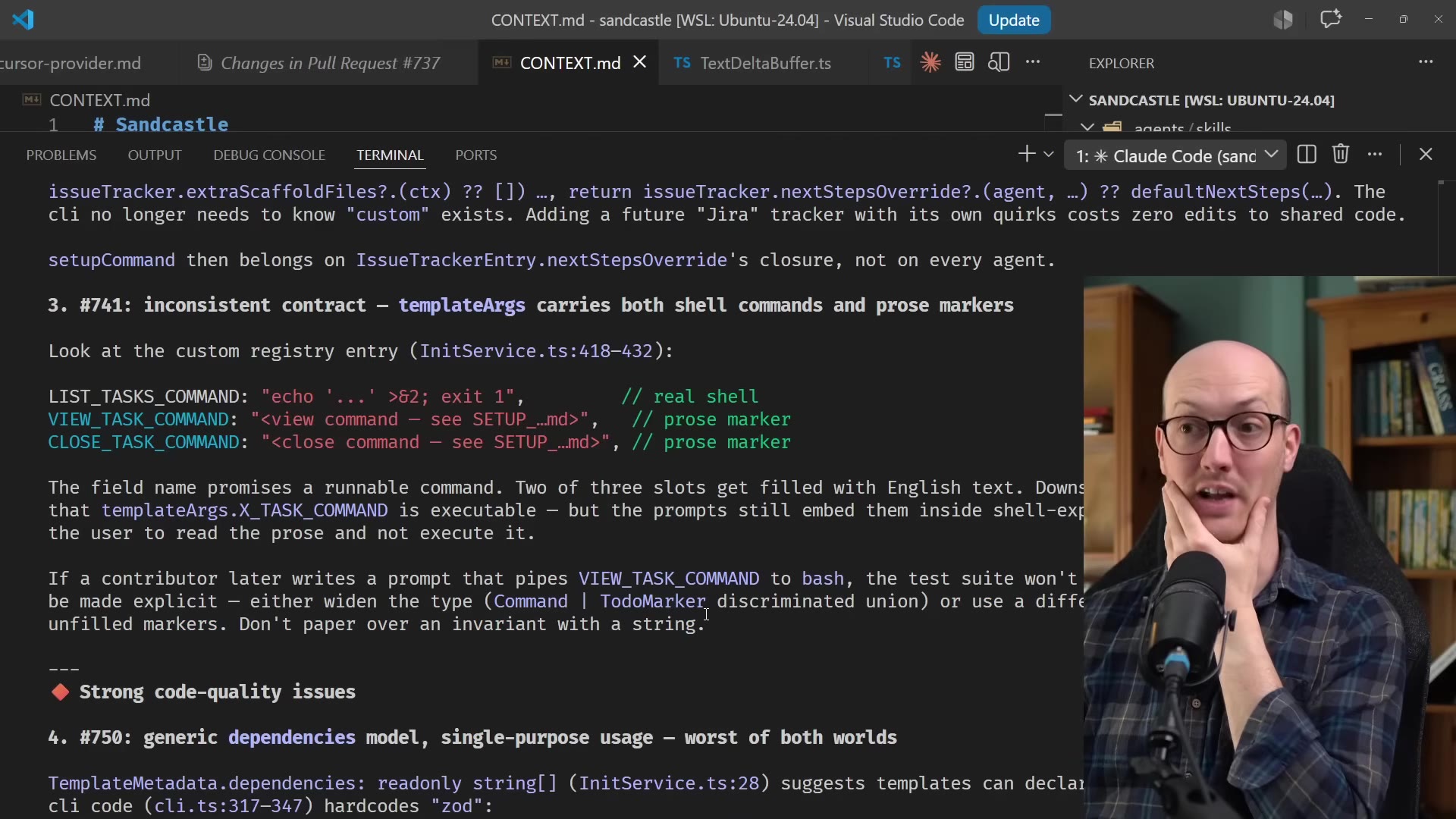
LIST_TASKS_COMMAND is real shell, the others are prose markers, so the field name lies about being runnable.The "worst of both worlds" abstraction
On PR #750: a generic dependencies: readonly string[] model that is only ever used for one value ("zod"), hardcoded in three places. The reviewer's line, "worst of both worlds," nails it: it pays the cost of a generic abstraction without the benefit. It also caught execSync inside Effect.sync with swallowed errors, and a file split that was only half finished. 10:00
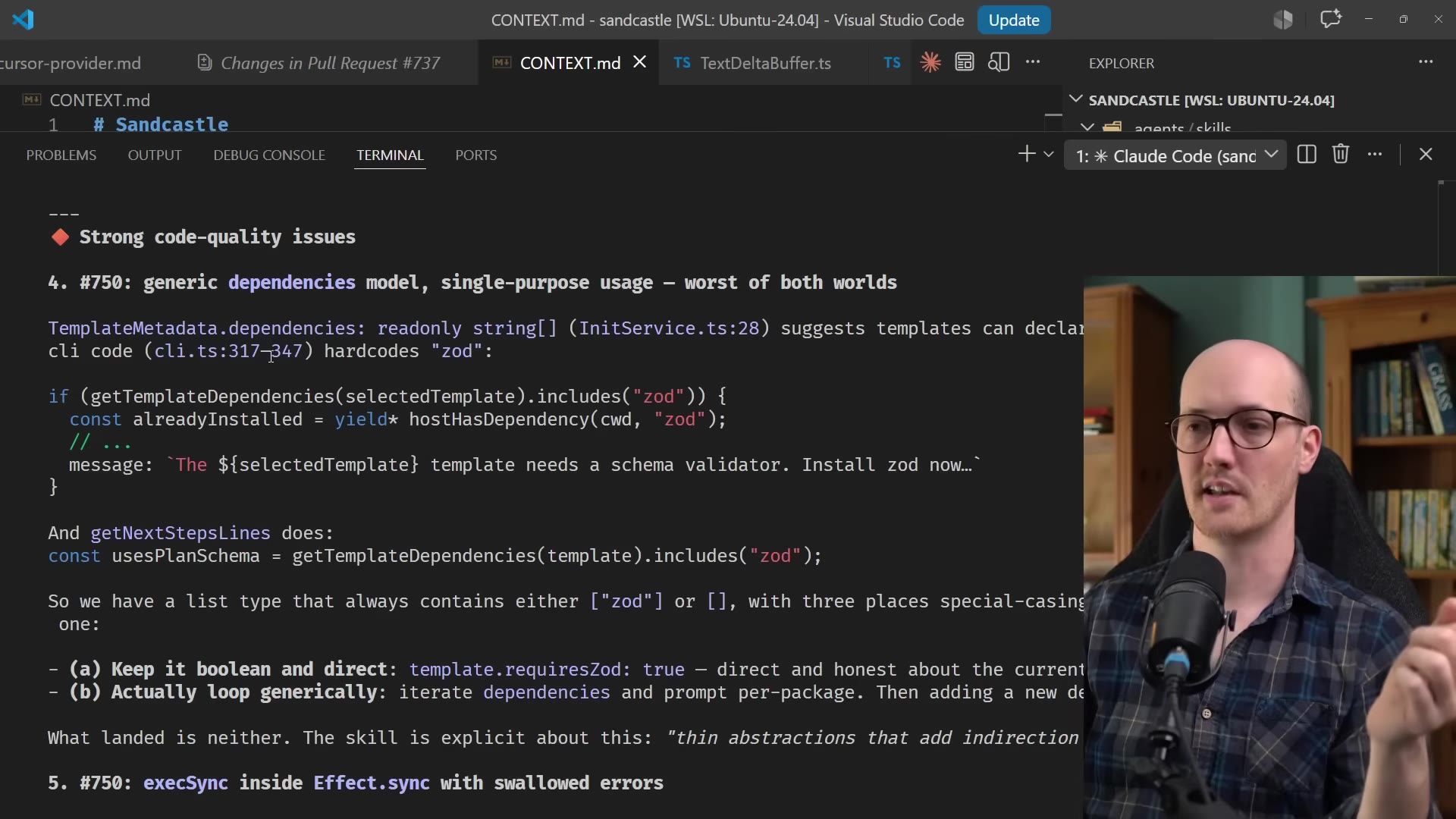
["zod"] or []: either be honestly boolean, or actually loop generically. What landed is neither.Where Matt pushes back
The reviewer flagged two prompt files whose diffs are byte-identical and wanted them factored into a shared partial. Matt disagrees: those prompts should stay independently changeable. Not every duplication is a DRY violation worth fixing. Final tally: about five of seven findings genuinely useful. 11:40
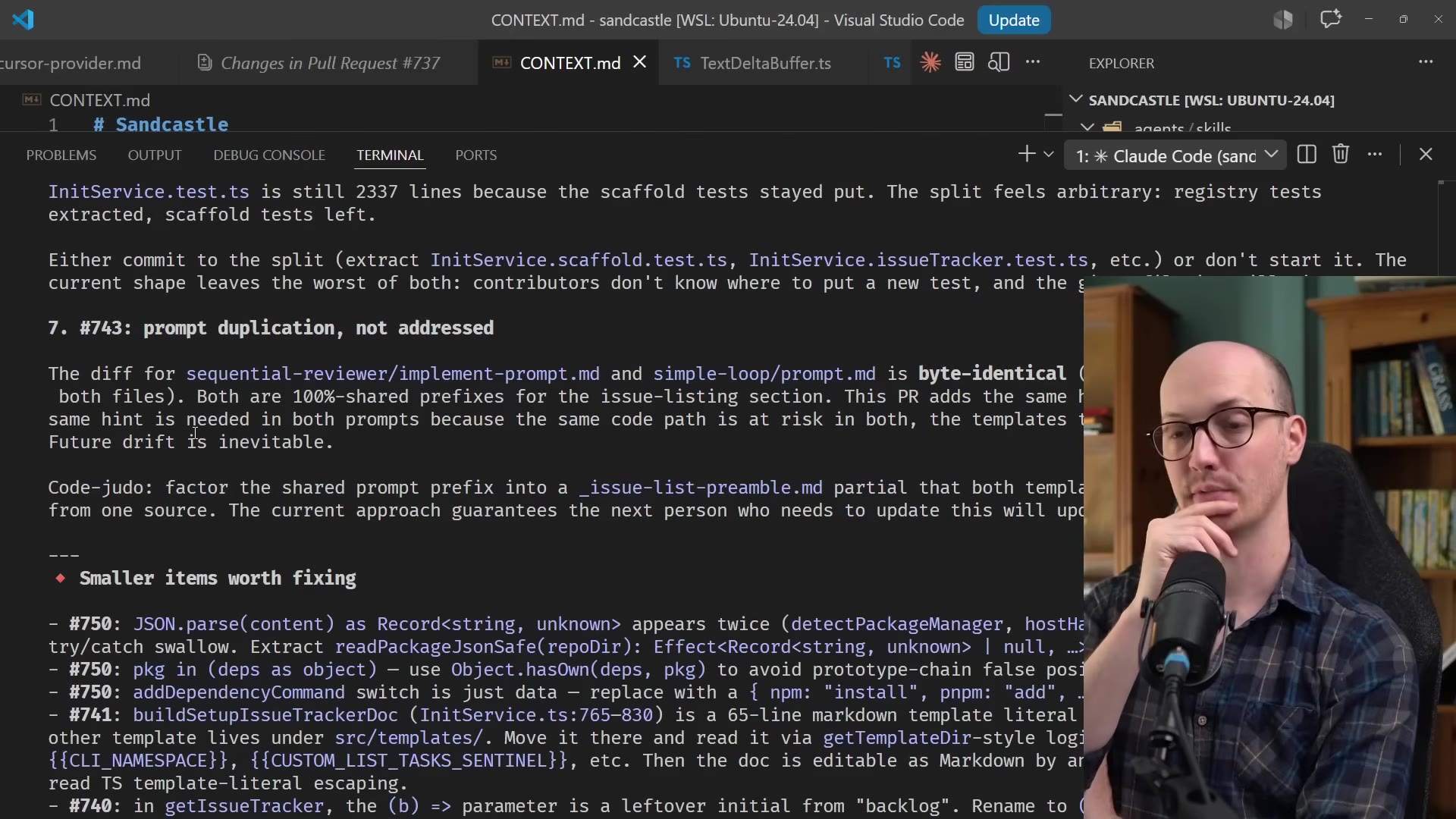
The final judgment
Against the skill's own approval bar, the verdict is a rejection: "#741 and #750 should not have landed in their current shape… The behavior is correct in all three substantive PRs, but the codebase is meaningfully messier than it was a week ago." The whole review "cooked for 2 minutes 35 seconds." 11:52
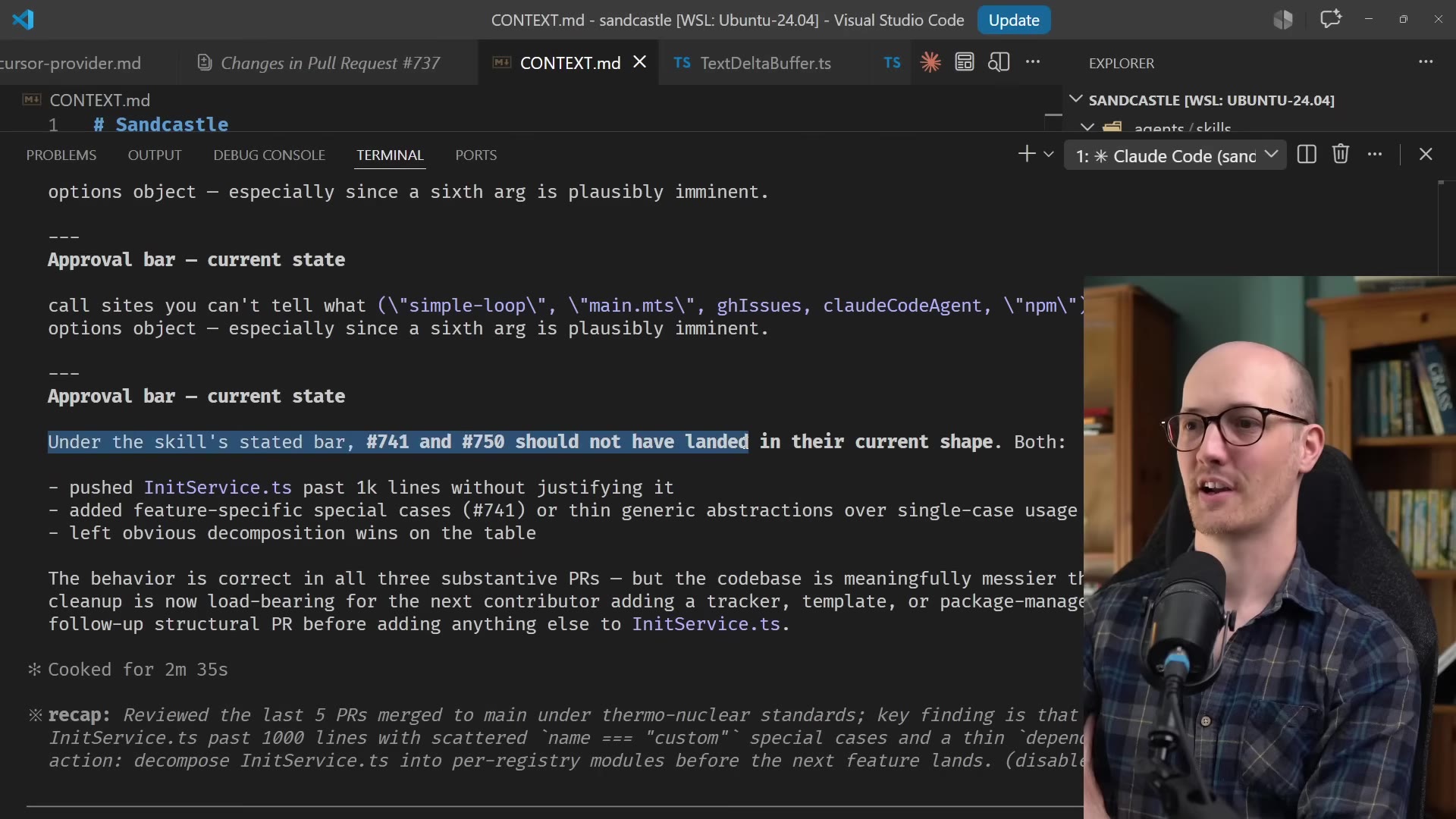
Matt is relaxed about the reviewer producing a few false positives. Why?
The reviewer rejected PRs whose behavior was completely correct. What principle does that demonstrate?
What Matt would change, and what to keep
The most valuable part of the lesson is the critique. A skill that scores 5/7 is useful, but Matt names two real weaknesses. 12:05
Ambition is the feature, not the bug
Making the reviewer aggressive produces more false positives, but each is a one-word "no." The silent misses, the improvements you never see, are the expensive ones. Bias toward ambition.
It's too repetitive — make it DRY
The skill says the same things many times. That "ball of mud" makes it hard for the agent to know what to prioritize. Matt would cut it down sharply.
The big gap: no tests, no seams
The skill never mentions seams, tests, or improving future feedback loops, which in Matt's view is the whole point of a healthy, changeable codebase. It reviews source only.
Define good and bad concretely
Vague questions like "does this improve the architecture?" are useless to an agent unless you spell out exactly what good and bad look like.
His overall verdict: worth pulling down and experimenting with. Steal the ambition and the concrete rules; add the tests-and-seams focus it's missing.
What is the single biggest thing Matt says the thermonuclear skill is missing?
Your score
One-sentence summary
An ambitious, whole-codebase review skill catches real structural problems an ordinary reviewer misses; the false positives it adds are cheap, but you still have to supply the tests-and-seams thinking it leaves out.
Glossary
Every term marked with a dotted underline above. Skim it, or search the page for a word.
Ideas worth stealing into your own setup
These are the moves from this video that could apply to your own agents and repos. They stay pinned at the bottom of the lesson. They are proposals, not done deals: nothing gets added to your system until you choose it.
01 A file-size + decomposition rule for your review standards
- Saw
- The skill blocks any PR that pushes a file from under to over ~1,000 lines without a strong reason. Matt's own equivalent threshold is 5,000 tokens.
- Why
- Keeps agent-written files navigable and context-efficient across your build repos, the same reason it helped here.
- Form
- A rule added to your impeccable / build review standards.
- Source
- 2:48 in the video
02 A "be ambitious beyond the diff" clause for your review agents
- Saw
- The skill tells the reviewer to scan the whole codebase for fixes, starting from the branch's changes, defeating the diff-bounds failure mode.
- Why
- Catches structural fixes your current review agents miss because they treat the diff as their boundary.
- Form
- A clause in your audit-verifier / code-review agent prompts.
- Source
- 1:36 in the video
03 A review skill that adds the tests-and-seams focus this one lacks
- Saw
- Matt's central critique: the skill reviews source only and never mentions tests, seams, or future feedback loops.
- Why
- A reviewer that also asks "are the seams and tests better after this change?" targets the real driver of a changeable codebase.
- Form
- A new or extended review skill.
- Source
- 12:05 in the video